

Is 1.7 A Irrational Number
1. Operations with Real Numbers
1.vii The Existent Numbers
By the cease of this department it is expected that you lot will be able to:
- Identify integers, rational numbers, irrational numbers, and real numbers
- Locate fractions on the number line
- Locate decimals on the number line
Identify Integers, Rational Numbers, Irrational Numbers, and Existent Numbers
We have already described numbers every bit counting number south , whole number s , and integers . What is the difference betwixt these types of numbers?

What blazon of numbers would nosotros go if we started with all the integers and then included all the fractions? The numbers we would have class the ready of rational numbers. A rational number is a number that tin be written as a ratio of two integers.
A rational number is a number of the class  , where p and q are integers and
  .
.
A rational number can be written as the ratio of 2 integers.
All signed fractions, such as  are rational numbers. Each numerator and each denominator is an integer.
Are integers rational numbers? To make up one's mind if an integer is a rational number, nosotros endeavor to write information technology as a ratio of two integers. Each integer can exist written as a ratio of integers in many ways. For example, 3 is equivalent to 
An like shooting fish in a barrel manner to write an integer as a ratio of integers is to write it equally a fraction with denominator one.

Since any integer can be written every bit the ratio of two integers, all integers are rational numbers! Think that the counting numbers and the whole numbers are also integers, and so they, likewise, are rational.
What about decimals? Are they rational? Permit's expect at a few to see if we can write each of them as the ratio of two integers.
We've already seen that integers are rational numbers. The integer  could be written as the decimal
  . So, clearly, some decimals are rational.
Think nearly the decimal 7.three. Tin can nosotros write it as a ratio of ii integers? Considering seven.3 means  , we tin can write information technology as an improper fraction,
  . And so 7.3 is the ratio of the integers 73 and x. It is a rational number.
In general, any decimal that ends after a number of digits (such equally 7.iii or  is a rational number. We tin use the place value of the terminal digit as the denominator when writing the decimal as a fraction.
Write as the ratio of two integers: a)  b) 7.31
Solution
| a) Write it as a fraction with denominator 1. |  |
| b) Write it as a mixed number. Recollect, vii is the whole number and the decimal part, 0.31, indicates hundredths. Convert to an improper fraction. |  |
So we run across that and 7.31 are both rational numbers, since they can be written as the ratio of two integers.
Write as the ratio of two integers: a)  b) 3.57
Show reply
a)  b)
b) 
Let'due south expect at the decimal grade of the numbers we know are rational.
Nosotros accept seen that every integer is a rational number, since  for any integer, a. We can also change any integer to a decimal by adding a decimal signal and a zero.
| Integer | -2 | -ane | 0 | 1 | 2 | 3 |
|---|---|---|---|---|---|---|
| Decimal class | -2.0 | -1.0 | 0.0 | 1.0 | 2.0 | 3.0 |
These decimal numbers stop.
We accept also seen that every fraction is a rational number. Expect at the decimal form of the fractions we considered above.
| Ratio of integers |  | – |  | – |
|---|---|---|---|---|
| The decimal form |  |  |  |  . . |
These decimals either stop or repeat.
What do these examples tell us?
Every rational number can be written both as a ratio of integers, ,where p and q are integers and ,and as a decimal that either stops or repeats.
Here are the numbers nosotros looked at above expressed as a ratio of integers and as a decimal:
| Number | |  | |  |
|---|---|---|---|---|
| Ratio of Integers | | | | |
| Decimal Form | | | |  |
| Number |  |  |  |  |  |  |
|---|---|---|---|---|---|---|
| Ratio of Integers |  |  |  |  |  |  |
| Decimal Form |  |  |  |  |  |  |
A rational number is a number of the class , where p and q are integers and .
Its decimal form stops or repeats.
Are there any decimals that do not terminate or repeat? Yes!
The number  (the Greek alphabetic character pi, pronounced "pie"), which is very of import in describing circles, has a decimal form that does non cease or repeat.
 .
.
We can even create a decimal design that does not stop or repeat, such as

Numbers whose decimal grade does not stop or repeat cannot exist written as a fraction of integers. We call these numbers irrational. More on irrational numbers later on is this course.
An irrational number is a number that cannot be written as the ratio of two integers.
Its decimal form does non stop and does non echo.
Let's summarize a method we can employ to make up one's mind whether a number is rational or irrational.
If the decimal grade of a number
- repeats or stops, the number is rational.
- does non repeat and does not stop, the number is irrational
Given the numbers  . list the a) rational numbers b) irrational numbers.
For the given numbers listing the a) rational numbers b) irrational numbers:  .
.
Show answer
a)  b)
b) 
For each number given, identify whether it is rational or irrational: a)  b)
b) 
For each number given, identify whether it is rational or irrational: a)  b)
b) 
Show answer
a) rational b) irrational
We have seen that all counting numbers are whole numbers, all whole numbers are integers, and all integers are rational numbers. The irrational numbers are numbers whose decimal course does non stop and does not repeat. When nosotros put together the rational numbers and the irrational numbers, we become the prepare of real number s.
A real number is a number that is either rational or irrational.
All the numbers nosotros utilize in algebra are real numbers. Figure 1 illustrates how the number sets we've discussed in this section fit together.
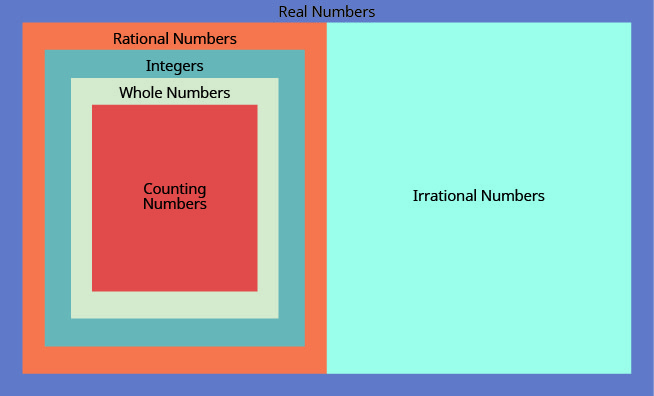
Do you recollect that the foursquare root of a negative number was not a existent number?
For each number given, identify whether information technology is a existent number or non a real number: ⓐ  ⓑ
ⓑ 
Solution
a) At that place is no existent number whose foursquare is  Therefore, is not a existent number.
b) Since the negative is in forepart of the radical,  is
is  Since is a real number, is a real number.
For each number given, identify whether information technology is a real number or not a real number: a)  b)
b) 
Show answer
a) non a existent number b) existent number
Given the numbers  list the a) whole numbers b) integers c) rational numbers d) irrational numbers e) real numbers.
Solution
a) Remember, the whole numbers are 0, i, 2, three, … and 8 is the simply whole number given.
b) The integers are the whole numbers, their opposites, and 0. And so the whole number 8 is an integer, and  is the contrary of a whole number so it is an integer, as well. Also, discover that 64 is the square of 8 so
  Then the integers are
c) Since all integers are rational, then  are rational. Rational numbers too include fractions and decimals that repeat or stop, so
  are rational. So the list of rational numbers is
d) Recollect that 5 is not a perfect square, and so  is irrational.
due east) All the numbers listed are real numbers.
For the given numbers, list the a) whole numbers b) integers c) rational numbers d) irrational numbers east) existent numbers: 
Locate Fractions on the Number Line
The last fourth dimension we looked at the number line, it merely had positive and negative integers on it. Nosotros at present want to include fractionsouth and decimals on it.
Let'southward outset with fractions and locate  on the number line.
We'll outset with the whole numbers and  . because they are the easiest to plot. Meet Figure 2.
The proper fractions listed are  . We know the proper fraction
  has value less than 1 and and then would be located between
  The denominator is 5, and then we divide the unit from 0 to 1 into 5 equal parts
  . We plot . Meet Figure ii.
Similarly,  is betwixt 0 and . After dividing the unit into v equal parts we plot . Meet Figure ii.
Finally, expect at the improper fractions  . These are fractions in which the numerator is greater than the denominator. Locating these points may be easier if yous change each of them to a mixed number. See Figure ii.

Figure 2 shows the number line with all the points plotted.

Locate and label the following on a number line:  .
.
Solution
Locate and plot the integers,  .
.
Locate the proper fraction  starting time. The fraction is between 0 and ane. Divide the altitude between 0 and 1 into 4 equal parts and so, we plot . Similarly plot
  .
.
Now locate the improper fractions  . It is easier to plot them if we convert them to mixed numbers and then plot them equally described above:
  .
.

Locate and label the following on a number line:  .
.
Show answer
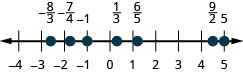
In Case 5, we'll utilize the inequality symbols to order fractions. In previous chapters we used the number line to order numbers.
- a < b "a is less than b" when a is to the left of b on the number line
- a > b "a is greater than b" when a is to the right of b on the number line
As we motility from left to right on a number line, the values increment.

Club each of the following pairs of numbers, using < or >:
a)  b)
b)  c)
c)  d)
d)  .
.
Show answer
a) > b) > c) < d) <
Locate Decimals on the Number Line
Since decimals are forms of fractions, locating decimals on the number line is similar to locating fractions on the number line.
Locate 0.4 on the number line.
Solution
A proper fraction has value less than i. The decimal number 0.4 is equivalent to  , a proper fraction, so 0.4 is located betwixt 0 and 1. On a number line, divide the interval between 0 and 1 into 10 equal parts. At present label the parts 0.1, 0.two, 0.iii, 0.4, 0.5, 0.half-dozen, 0.seven, 0.8, 0.9, 1.0. We write 0 as 0.0 and i and 1.0, then that the numbers are consistently in tenths. Finally, mark 0.4 on the number line. See Figure 4.

Locate on the number line: 0.6
Bear witness respond

Locate  on the number line.
Locate on the number line:  .
.
Testify answer
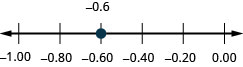
Which is larger, 0.04 or 0.forty? If you think of this as coin, y'all know that ?0.40 (forty cents) is greater than ?0.04 (iv cents). So,
 >
> 
Again, we tin use the number line to gild numbers.
- a < b "a is less than b" when a is to the left of b on the number line
- a > b "a is greater than b" when a is to the right of b on the number line
Where are 0.04 and 0.40 located on the number line? Meet Figure vi.

We see that 0.40 is to the right of 0.04 on the number line. This is another way to demonstrate that 0.40 > 0.04
How does 0.31 compare to 0.308? This doesn't interpret into money to brand it easy to compare. Only if we convert 0.31 and 0.308 into fractions, nosotros tin tell which is larger.
| 0.31 | 0.308 | |
| Catechumen to fractions. |  |  |
| We need a common denominator to compare them. |  |  |
 | |
Because 310 > 308, we know that > . Therefore, 0.31 > 0.308
Notice what we did in converting 0.31 to a fraction—we started with the fraction and ended with the equivalent fraction . Converting dorsum to a decimal gives 0.310. So 0.31 is equivalent to 0.310. Writing zeros at the end of a decimal does not change its value!

Nosotros say 0.31 and 0.310 are equivalent decimals.
Two decimals are equivalent if they convert to equivalent fractions.
We use equivalent decimals when we order decimals.
The steps nosotros take to guild decimals are summarized here.
- Write the numbers i under the other, lining upwardly the decimal points.
- Check to see if both numbers take the same number of digits. If not, write zeros at the end of the i with fewer digits to make them match.
- Compare the numbers as if they were whole numbers.
- Lodge the numbers using the appropriate inequality sign.
Order  using < or >.
Social club each of the following pairs of numbers, using  >
>  .
.
Order  using < or >.
Social club the following pair of numbers, using >  .
.
When we order negative decimals, information technology is important to recall how to order negative integers. Think that larger numbers are to the correct on the number line. For case, considering lies to the right of  on the number line, nosotros know that > . Similarly, smaller numbers lie to the left on the number line. For example, considering
  lies to the left of
  on the number line, we know that
  . Run across Figure 7.

If we zoomed in on the interval between 0 and , every bit shown in Example 10, we would come across in the same way that  >
>  .
.
Use < or > to club  .
.
Order the following pair of numbers, using < or >:  .
.
Key Concepts
- Order Decimals
- Write the numbers one nether the other, lining up the decimal points.
- Bank check to run into if both numbers have the same number of digits. If not, write zeros at the finish of the one with fewer digits to make them match.
- Compare the numbers equally if they were whole numbers.
- Society the numbers using the advisable inequality sign.
Glossary
1.7 Exercise Set
In the post-obit exercises, write every bit the ratio of ii integers.
-
- 5
- 3.19
-
-

- 9.279
-
In the following exercises, listing the a) rational numbers, b) irrational numbers


In the following exercises, list the a) whole numbers, b) integers, c) rational numbers, d) irrational numbers, e) real numbers for each set of numbers.
![-8,0,\sqrt[5]{-32} , 1.95286\text{…},\frac{12}{5},\sqrt[2]{-9},\sqrt[3]{9}](https://opentextbc.ca/businesstechnicalmath/wp-content/ql-cache/quicklatex.com-1d85f484469818ec318ae0b46a0d8057_l3.png "Rendered by QuickLaTeX.com")
![-7,\sqrt[3]{512} ,-\phantom{\rule{0.2em}{0ex}}\frac{8}{3},-1, \sqrt[4]{-75}, 0.77,3\frac{1}{4}](https://opentextbc.ca/businesstechnicalmath/wp-content/ql-cache/quicklatex.com-30d30b15249cb7338af8575d45732729_l3.png "Rendered by QuickLaTeX.com")
Answers:
-
-
-
-
-
-
-
-
-
-
-
-
![\sqrt[3]{512}](https://opentextbc.ca/businesstechnicalmath/wp-content/ql-cache/quicklatex.com-07742bd0b9c49b651cd1aa956d22b337_l3.png "Rendered by QuickLaTeX.com")
-
![-7,-1, \(\sqrt[3]{512}](https://opentextbc.ca/businesstechnicalmath/wp-content/ql-cache/quicklatex.com-f81d769284bc127cf1af90efdd017f3e_l3.png "Rendered by QuickLaTeX.com")
- -vii,
![-\phantom{\rule{0.2em}{0ex}}\frac{8}{3},-1,0.77,3\frac{1}{4}, \(\sqrt[3]{512}](https://opentextbc.ca/businesstechnicalmath/wp-content/ql-cache/quicklatex.com-9e51bea8cadd04b1072c1733e85eff55_l3.png "Rendered by QuickLaTeX.com")
- none
-
![-7,-\phantom{\rule{0.2em}{0ex}}\frac{8}{3}, -1,0.77,3\frac{1}{4}, \(\sqrt[3]{512}](https://opentextbc.ca/businesstechnicalmath/wp-content/ql-cache/quicklatex.com-96c2da2e381d7646d419cdb199147763_l3.png "Rendered by QuickLaTeX.com")
-


![-8,0, \sqrt[5]{-32}](https://opentextbc.ca/businesstechnicalmath/wp-content/ql-cache/quicklatex.com-78b9f9eb6df48f7c94fe21e84c04f4b8_l3.png "Rendered by QuickLaTeX.com")
![-8,0,\sqrt[5]{-32}, \frac{12}{5}](https://opentextbc.ca/businesstechnicalmath/wp-content/ql-cache/quicklatex.com-0a58f966900a99c10f5ce303e2bcd561_l3.png "Rendered by QuickLaTeX.com")
![1.95286\text{…}, \sqrt[3]{9}](https://opentextbc.ca/businesstechnicalmath/wp-content/ql-cache/quicklatex.com-a7956177e941387825bfd06259bdf875_l3.png "Rendered by QuickLaTeX.com")
![-8,0, \sqrt[5]{-32}, 1.95286\text{…},\frac{12}{5},\sqrt[3]{9}](https://opentextbc.ca/businesstechnicalmath/wp-content/ql-cache/quicklatex.com-7ba7319f055030d2ca433993135f5a5e_l3.png "Rendered by QuickLaTeX.com")
- <
- >
- >
- <
-
- <
- >
- <
- <
-
- iv buses
- answers may vary
- answers may vary
Attributions
This chapter has been adjusted from "The Real Numbers" in Elementary Algebra (OpenStax) by Lynn Marecek and MaryAnne Anthony-Smith, which is under a CC Past iv.0 Licence. Adjusted by Izabela Mazur. See the Copyright page for more information.

Is 1.7 A Irrational Number,
Source: https://opentextbc.ca/businesstechnicalmath/chapter/1-7-the-real-numbers/
Posted by: creedhicestowill.blogspot.com
0 Response to "Is 1.7 A Irrational Number"
Post a Comment